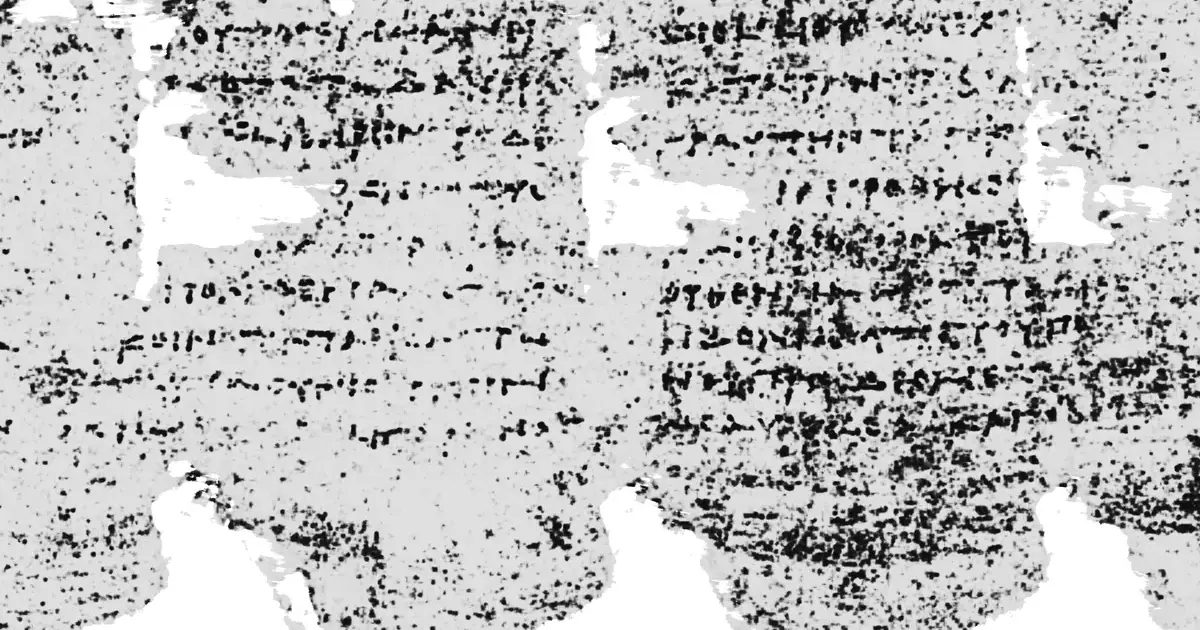
An entire Herculaneum scroll has been read for the first time
Researchers have virtually unwrapped and read the Herculaneum scroll PHerc. 1667, sealed since the eruption of Vesuvius in 79 AD, from beginning to end. The recovered text is a Stoic treatise on ethics, dated to the 2nd century BC.
An entire Herculaneum scroll has been read for the first time without being opened. The Vesuvius Challenge announced on June 25, 2026 that PHerc. 1667 — a papyrus sealed since the eruption of Mount Vesuvius in 79 AD — has been virtually unwrapped and read from beginning to end.
A carbonised roll turned into a readable book
PHerc. 1667, known in the community as Scroll 4, survived the eruption only by carbonising, which left it too fragile to open. Earlier attempts to unroll it by hand, in the nineteenth century and again in 1969 and the 1980s, destroyed its outer layers and left a compact core of about 8 cm from an original height of 19–24 cm.
Instead of unrolling it, the team scanned the roll with high-resolution X-rays, reconstructed the sheet wound inside the volume, flattened it into a readable surface and used machine-learning models to detect ink almost indistinguishable from the carbonised papyrus. The result is roughly 1.4 metres of writing surface and about twenty-two columns of Greek, transcribed and reviewed by papyrologists.
A Stoic treatise on ethics
The recovered text is a philosophical treatise on ethics, and the evidence points to a Stoic work: it turns on human nature, impulse and the moral progress of human beings, and its last preserved column names Aristocreon, nephew and disciple of Chrysippus. That, with the language and themes, dates it to the 2nd century BC.
Because the papyrus is damaged, the readings are fragmentary, with gaps where the surface is lost. Several passages can nonetheless be read clearly for the first time in two thousand years, among them a line about departing from ourselves and from our own nature.
Two more scrolls, two more milestones
The paper reports two further results. In PHerc. Paris 4, or Scroll 1, a higher-resolution technique made the ink directly visible inside the roll, in the three-dimensional X-ray data; segmented in 3D and projected onto the unwrapped page, it matches the reading that won the 2023 Grand Prize one-to-one. In PHerc. 139, researchers recovered the title and author: the work is Philodemus, On Gods, Book 8.
Open data, open method
The scans were made with phase-contrast X-ray microtomography on the BM18 beamline at the European Synchrotron Radiation Facility in Grenoble, with the National Library of Naples. The data, reconstructed surfaces and transcriptions are released under a Creative Commons licence, and the code is public.
Virtual unwrapping was pioneered at EduceLab by Professor Brent Seales, who opened his lab's technology to the Vesuvius Challenge in 2023. Much of the team behind this result first arrived as contestants. Hundreds of scrolls remain sealed.