Laya: an open decision engine built a year before a frontier lab called the idea new
After a well-funded lab launched a similar non-autoregressive model as a breakthrough, an engineer released Laya: open-weight System 1 decision models that return calibrated probabilities in 32.8 ms.
An engineer who published non-autoregressive decision models a year ago has released a fully open alternative after a well-funded frontier lab presented a similar architecture as a new scientific breakthrough.
A year-old idea presented as new
Nandakishor Mukkunnoth, founder and CEO of ConvAI Innovations, writes that he built the approach in March 2025: an arXiv paper on sequence conversion trajectories, model weights and an open dataset on Hugging Face, and a PyPI package. Then, in September 2026, TypeSafe AI - founded by Diogo Almeida, a co-inventor of ChatGPT - launched Jev, which he describes as the same non-autoregressive decision concept, but shipped without technical papers, open weights or open training datasets. Jev samples in parallel using what it calls RLCD, Reinforcement Learning for Calibrated Decisions, and charges $0.042 per million input tokens with typical response times around 150 ms.
What Laya is
Rather than stay bitter, he rebuilt the idea as Laya, a System 1 decision engine: it does not generate text, only probability distributions over structured schemas. It answers three primitives - choice, which picks one key from a dictionary and returns the distribution and a calibrated confidence; score, which places a document on an ordinal rubric such as 0 to 3; and noul, a boolean question returning P(true). Because the output space is numbers only, the model cannot hallucinate and malformed JSON is impossible, the author argues. On bidirectional encoders it answers in 32.8 ms on a single GPU, or 7.2 ms per question batched, which the page says is six to eight times faster than Jev, with Apache 2.0 weights and no API cost.
Three checkpoints and a router
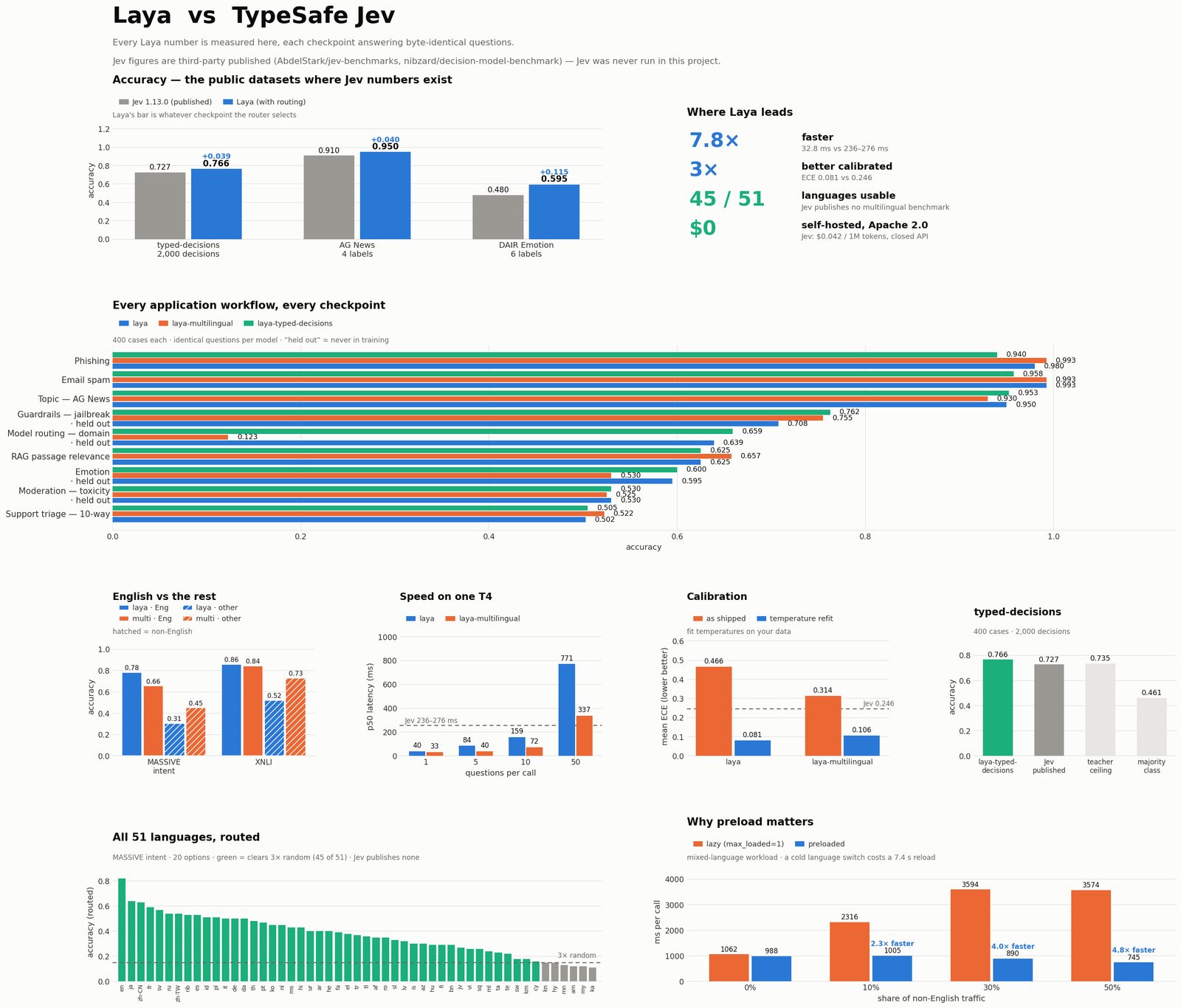
The family ships three checkpoints in one Hugging Face repository: laya (ModernBERT-large, 421M parameters, 512-token context) for English classification and email triage; laya-multilingual (mmBERT-base, 256k vocabulary, 322M parameters) for over 100 languages; and laya-typed-decisions for agent workflows at 0.766 accuracy. A 51-language sweep on the MASSIVE benchmark showed how English-only models collapse outside Latin script: on Khmer the model scored 0.000 accuracy at 0.952 mean confidence. Confidence never fell below 0.885 whether accuracy was 82% or zero, so gating on confidence cannot protect a pipeline - the routing decision has to happen before the forward pass. Laya's router inspects Unicode scripts across 22 alphabets, adding 0.09 ms for English, 0.54 ms for Indic text and 0.73 ms for large nested JSON, and preloading avoids a 7 to 10 second cold swap.
Benchmarks and honest limits
On shared benchmarks the routed system reports 0.950 against Jev's 0.910 on AG News and 0.595 against 0.480 on DAIR Emotion, with an expected calibration error of 0.081 against 0.246 and a median latency of 32.8 ms against 236 to 276 ms. The page also lists ceilings: choice schemas degrade above 20 options, scoring 0.425 on Banking77 against Jev's 0.870; base models land near 0.35 zero-shot before fine-tuning; and fitting one temperature scalar per question type cuts calibration error from 0.466 to 0.081.
SiTech — AI-powered web development
We build fast, modern websites and bring AI into real business workflows. Have a project or a question? We'd love to help.