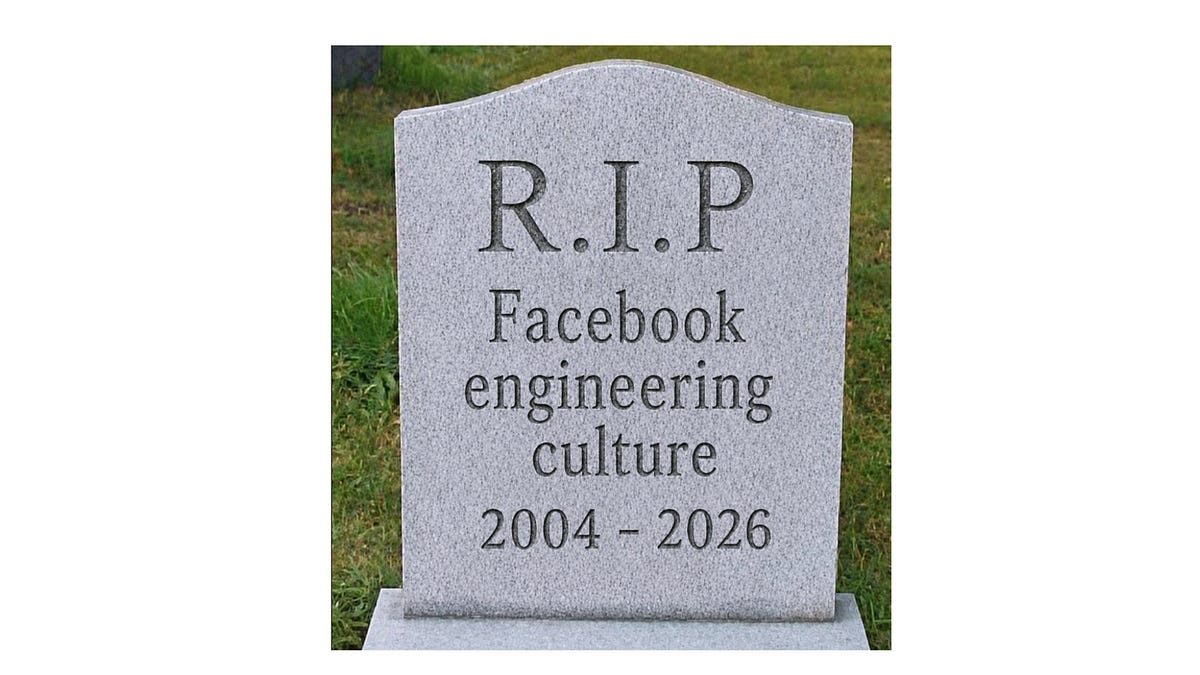
Is Meta dismantling its engineering org? Inside the AI-driven upheaval
A long report in the Pragmatic Engineer newsletter traces Meta's spring 2026: keystroke tracking, mass reassignment to AI data labeling, 10 percent layoffs and an embarrassing Instagram account-takeover incident.
For two decades Meta built one of the most engineering-centric cultures in Big Tech, moving from the "move fast and break things" era of the 2010s to a later "move fast with stable infra" principle. That reputation came under strain this spring: a long report in the Pragmatic Engineer newsletter describes a run of decisions taken by leadership since late April and their effect on the engineers who build Facebook, Instagram and Messenger.
Keystroke tracking and mass reassignment
In late April, the newsletter reports, Meta told engineers they were being enrolled in a system that records every keystroke and mouse click to produce training data for the company's new AI models, with no way to opt out. On 2 June, Reuters reported that Meta is scaling parts of that plan back: an internal memo by Stephane Kasriel, a vice president in Meta's Superintelligence Labs unit, says new controls will let employees pause collection for up to 30 minutes at a time and request exemptions. Product engineering teams, meanwhile, were told that 30 to 50 percent of their engineers would move to the ADO organisation — Agent Data Optimisation — for data labeling and reinforcement learning from human feedback. The newsletter puts the ADO org at around 6,500 people, more than OpenAI or Anthropic employ, roughly 4,000 to 5,000 of them software engineers.
Layoffs, reviews and the Instagram incident
Reuters reported on 20 April that Meta planned to cut 10 percent of staff within a month; the layoffs were announced on 20 May, leaving four weeks of uncertainty. The newsletter adds that performance reviews at Meta are unusually aggressive and that token counts were to be inspected during them, encouraging engineers to generate AI output for the sake of the metric. On 30 May, Instagram accounts — including high-profile ones — were taken over. According to an engineer's write-up quoted in the report, an attacker could fake their location with a VPN and ask Meta's support AI to send verification codes to an email address they controlled — a password reset with effectively zero authentication. The incident was resolved on 1 June, and Meta's chief information and security officer, Guy Rosen, announced his departure the next day. The newsletter's sources say Instagram's Trust and Safety team had lost about half its staff, and that AI-written changes reviewed only by AI had become common.
Fallout and the wider warning
Internally, Wired reported that an employee interrupted a livestreamed staff presentation with an expletive-filled outburst, and that chief product officer Chris Cox described the recent environment as "brutal". CTO Andrew Bosworth has since acknowledged that the AI reorganisation was handled badly. The newsletter notes that some of the damage is being reversed: in the UK, several infrastructure and security teams learned at the end of the consultation period that no one on their team would be let go. Its broader argument, echoed by HashiCorp founder Mitchell Hashimoto, is that companies gripped by "AI psychosis" risk trading resilience for speed — a lesson infrastructure teams learned long ago.
SiTech — AI-powered web development
We build fast, modern websites and bring AI into real business workflows. Have a project or a question? We'd love to help.