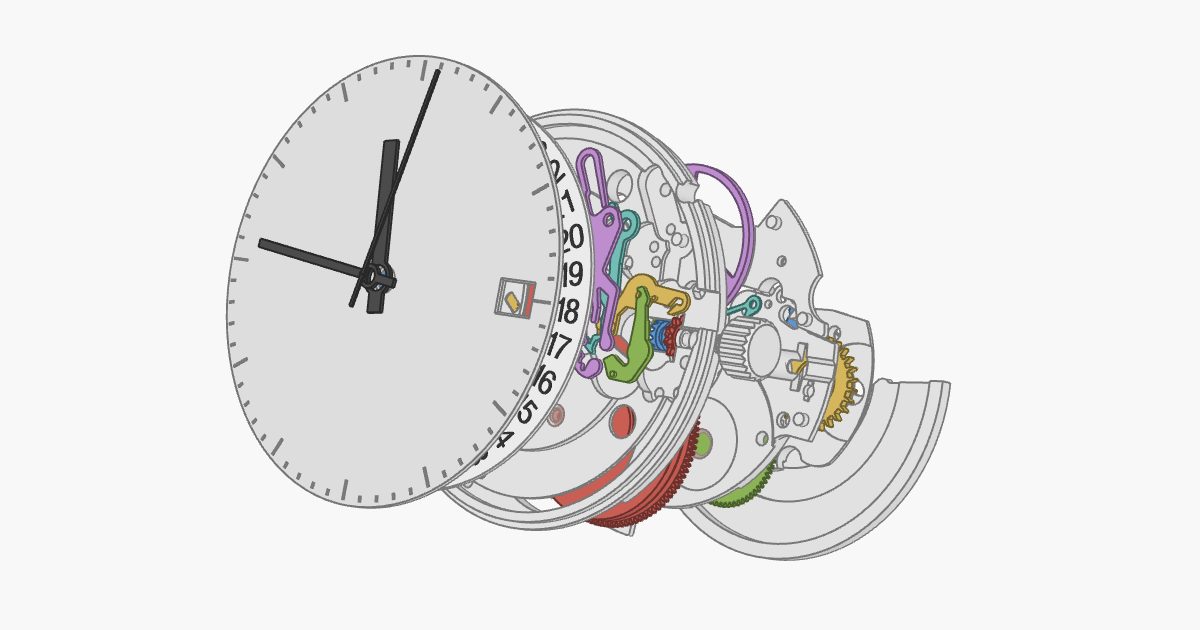
Mechanical Watch: an interactive deep dive into how a watch movement works
Bartosz Ciechanowski's long interactive essay takes a mechanical watch apart in the browser, from mainspring and gear train to escapement, balance wheel and automatic winding.
The engineering blog of Bartosz Ciechanowski hosts a long interactive essay titled Mechanical Watch, first published in 2022, that takes a mechanical timepiece apart and explains every part of it in the browser. The subject is the movement — the inner assembly that a watch case normally hides — because, as the author puts it, beautiful cases merely conceal the intricate mechanism that is the real star of the show.
Energy: mainspring, barrel and arbor
Power comes from a spiral torsion spring. The mainspring is wound inside a casing called the barrel, and an arbor with a small hook grabs a hole near the spring's end and pulls it tight when turned. The essay shows how a metal strip attached to the outer end pushes against the barrel wall, generating friction that locks the outer end in place and lets the spring slip if it is overwound — a safety mechanism. A lid snaps onto the barrel to hold the spring and keep dust out. The demonstrations make the numbers concrete: a single wind should keep a watch running for around 40 hours, during which the second hand must complete roughly 2,400 turns while the barrel rotates only about seven times.
Gears and the escapement
Turning seven rotations into 2,400 calls for a ratio near 343 to 1, and the essay shows why a single giant gear pair would be absurd: the driven wheel would have to be microscopic, with impossibly fragile teeth. Mechanical watches instead use a train of wheels — the barrel acts as the first wheel and drives the second, then the third and fourth, each large gear turning a smaller pinion mounted on the next shaft. Watches also commonly use cycloidal tooth profiles, unlike the involute teeth of larger machines. The release of energy is governed by the escapement: an escape wheel and a pallet fork whose tips carry jewels made of synthetic ruby, chosen for hardness and for a low coefficient of friction against steel.
The balance, automatic winding and scale
Timing itself comes from a torsion spring with a mass attached: the balance wheel and its balance spring oscillate back and forth, and their period is set by the stiffness of the spring and the moment of inertia of the wheel. A further section covers automatic winding, where a weight that swings with the wearer's arm drives the spring through a pair of one-directional gears and small levers, and a final demonstration shows the whole movement inside an outline the size of a credit card. The author closes with the 1970s, when quartz movements began to displace mechanical watches: they are less accurate, need maintenance and are more fragile, yet they remain a demonstration of genuine engineering mastery.
SiTech — AI-powered web development
We build fast, modern websites and bring AI into real business workflows. Have a project or a question? We'd love to help.