Developer rebuilds his homepage with 60 parallel Claude threads, without writing code
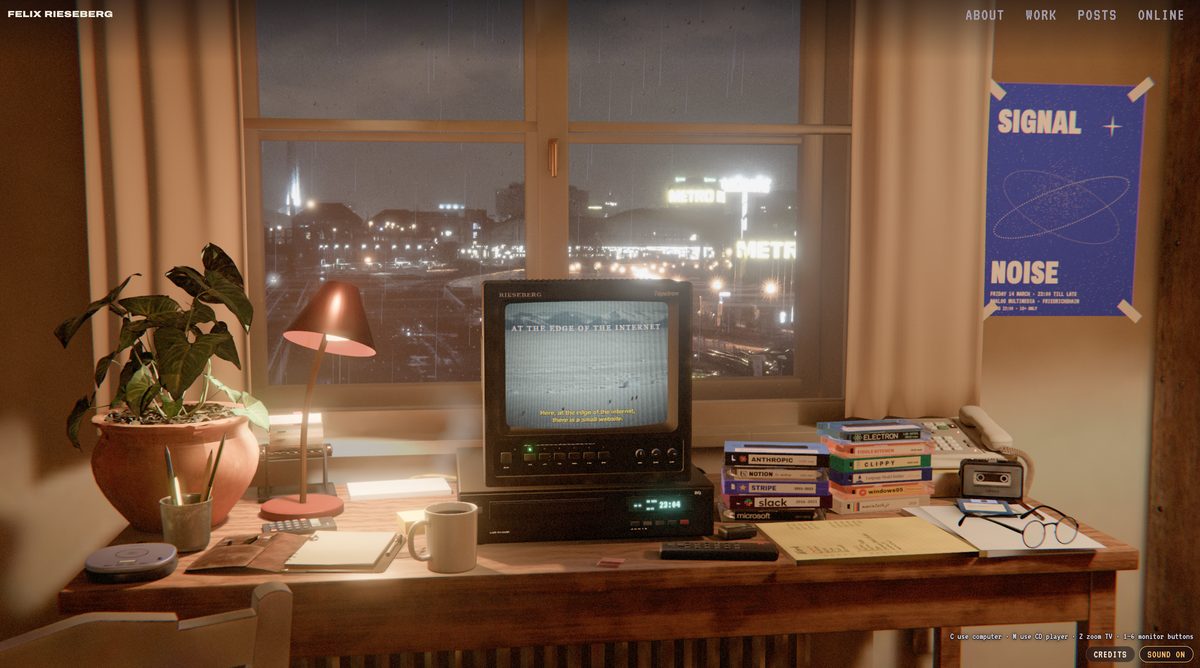
Developer Felix Rieseberg rebuilt his personal homepage entirely with agentic AI assistance: no code ran locally and GitHub was never used. Roughly 60 parallel Claude threads produced a 3D room, three soundtracks and a CGI parody.
Developer Felix Rieseberg rebuilt his personal homepage entirely with agentic AI assistance, without writing or running any code locally. In an essay published in late September 2026, "Made by Mechanical Means", he describes how roughly 60 parallel Claude threads produced a 3D room, three soundtracks and a CGI parody.
No pull requests were opened, GitHub was never used and Rieseberg did not even reach for Claude Code, the dedicated coding tool. He simply used Claude with the Opus 5.5 model, and the generic harness never needed to be told that it was writing code.
One Claude per project
The workflow begins with a Claude Project. Each thread gets its own computer in the cloud, installs what it needs, including Blender, FFmpeg and Playwright, checks its work with screenshots from a headless browser and publishes a private preview page. One shared folder and one shared memory keep recorded decisions binding for every agent. Rieseberg reviewed the work from his phone, sending notes while riding his bike.
A room built from Python and Blender
At the centre is an interactive room inspired by 90s German cinema, combined with an idea Claude contributed: a gallery of VHS tapes. Claude does not click around Blender's interface; it writes code and drives Blender as a Python module. The room is now about 3,000 lines of Python.
Separate scripts model a VHS cassette, a journalist's desk with a Rolodex, floppies and a Walkman, a beige PC with a 14-inch green CRT. Most props were made by Claude itself.
Penguins, music and adversarial review
The author's favourite part is a parody of the "nihilistic penguin" scene from Herzog's Encounters at the End of the World: eight shots and 2,787 rendered frames at 23.976 fps, a 116-second video.
Claude also composed and synthesised three soundtracks from scratch in Python, while voice-over work moved to ElevenLabs after open-source models proved weak.
Rieseberg borrowed a technique from engineering management and tasked adversarial agents with breaking the site. QA threads logged about 3,000 lines of findings: blank cassette labels, leftover German text and a race condition when switching tapes quickly.
Why it matters
Rieseberg acknowledges that the approach will upset people who learned 3D modelling by hand, and compares the reaction to Electron's effect on desktop development and to the rise of AI-assisted coding.
He cites a Matisse exhibition in San Francisco, where a 1905 critic dismissed the painter and his friends as "wild beasts". His own homepage, he writes, was made entirely through mechanical means.
SiTech — AI-powered web development
We build fast, modern websites and bring AI into real business workflows. Have a project or a question? We'd love to help.