Meta's Muse appears to route one session to an OpenAI model labeled muse-special
A second teardown of Meta's Muse agent runtime found a single session tied to a model labeled azure/muse-special, whose transcript signature and tool call IDs point to OpenAI's Responses API served through Azure.
A follow-up teardown of Meta's Muse agent runtime points to a model labeled azure/muse-special that appears to be OpenAI's, served through Azure. Blogger Peter James published it on mouse.dev; his earlier Muse filesystem article hit Hacker News' front page.
One odd session
Muse records the model behind each agent session. Nearly every session log in the author's virtual machine ran on Meta's internal model, Avocado, but one subagent used azure/muse-special, in a single session dated September 21.

A repository search inside Cursor returned the string "GPT Responses model client via MAGI native Azure OpenAI lane"; the catalogue lists azure/muse-special before azure/gpt-5.6-sol.
Two transcript details stood out: a signature tagged gpt_responses_v1 with an encrypted payload starting gAAAAA, a pattern OpenAI uses, and call_ IDs of 24 mixed-case characters, where Avocado prints 32 hexadecimal ones. In his reading, muse-special is most likely an alias for a GPT model served through Azure.
What ships with the runtime
The catalogue bundled with Muse's agent daemon lists around 15 Avocado versions, plus Claude Opus 4.6, 4.7 and 4.8, Sonnet 4.6, Haiku 4.5, GPT-5.5 and GPT-5.6 variants via OpenAI, Azure and Codex, and Kimi K3 via Fireworks. A shipped ID means a model can be addressed, not that it was used, he notes.
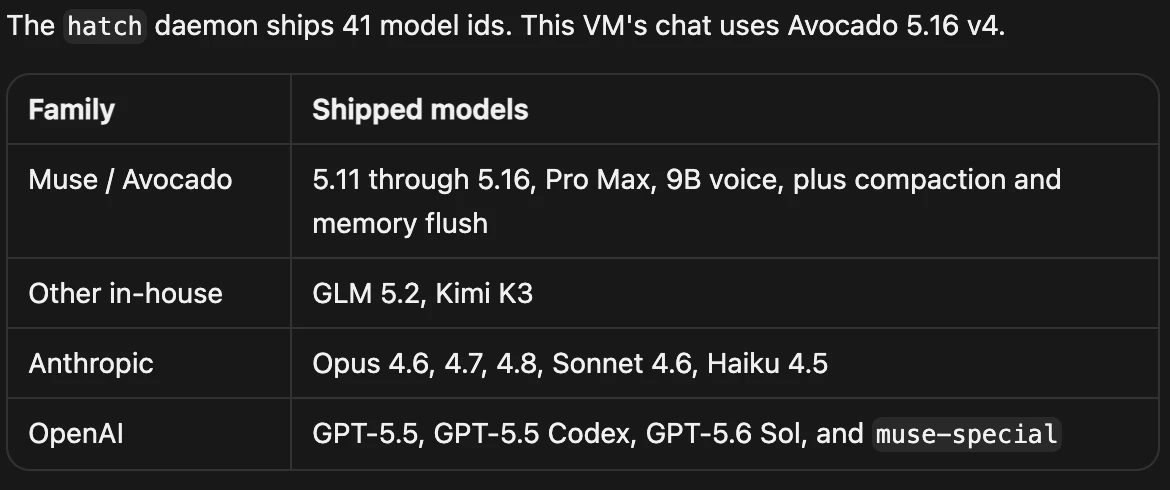
Anthropic support goes past the model ID: the repository holds a client with request handling, prompt conversion and streaming parsers, API key files restricted to the inference-proxy service, and a proxy setting he calls a live kill switch.
Is Meta distilling from rivals?
His answer is no. With muse-special the raw reasoning is encrypted and stored to be sent back to Azure next turn, and the binary says it cannot use the RL completion-server override. Meta sees only the reply, the tool calls and a short summary.
Avocado differs: its thinking text goes into the transcript with an empty signature and is available for RL, and the privacy note indicates conversations can be used to develop AI at Meta unless a user opts out.
Routing stays a server-side choice, so the provider can change without asking users. His best guess: muse-special is an OpenAI model served through Azure.
SiTech — AI-powered web development
We build fast, modern websites and bring AI into real business workflows. Have a project or a question? We'd love to help.