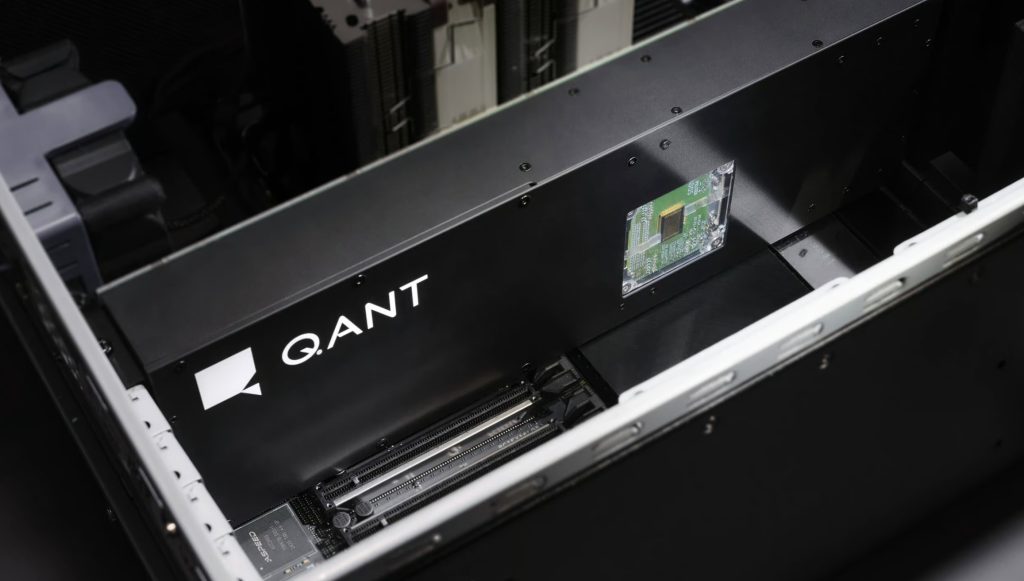
Q.ANT open-sources a CUDA-style toolkit for its light-powered AI chips
The Stuttgart startup has published a free, commercial-use software kit on GitHub that lets developers write and test code for its photonic processors on an ordinary computer, with chip access promised in the coming months.
Q.ANT, a startup based in Stuttgart, Germany, builds processors that use light instead of electricity for part of the math behind AI. This week it pushed a free, open-source software kit to GitHub so developers can write and test programs on a normal computer and later run them on real chips.
What is in the kit
The Q.ANT Native Computing Toolkit is free on GitHub under a licence that allows commercial use, and developers can work in Python or C. Its key component is a simulator that mimics the chip on an ordinary machine, with no Q.ANT drivers required. This first version runs already-trained models: examples read handwritten digits, identify objects in photos and outline shapes, while training still happens on conventional CPUs and GPUs.
Why light
The pitch for photonic computing is power: AI chips burn a lot of energy moving data between memory and the processor. Q.ANT's chips do part of the math with light, wave-shaped functions similar to a cosine that ordinary chips calculate digitally. Q.ANT says models built around them reach better results with fewer parameters — a smaller model, less data movement and less power. The comparisons in the kit are the company's own.
“An ecosystem isn't created by hardware alone. It emerges when the software layer is open and others can build on it,” said founder and CEO Michael Förtsch, who called the release the “Linux moment” of photonic computing.
A page from Nvidia's playbook
The strategy mirrors Nvidia, whose lead in AI rests as much on CUDA, the software used to program its GPUs, as on the chips themselves. Nvidia has been building CUDA for nearly 20 years; Graphcore, the British AI chip startup, also shipped its own software kit but was still sold to SoftBank in 2024. Q.ANT's constraint is hardware: its chips run at a few research computing centres, and everyone else must wait “the coming months” for cloud access through the German provider IONOS or an on-site server.
Numbers and caveats
Q.ANT raised €62 million in July 2025 in a round led by Cherry Ventures, UVC Partners and imec.xpand, and said in March that its second-generation chips were running at the Leibniz Supercomputing Centre near Munich. Published results compare the new chip with its predecessor: more than 50 times faster at the math that does most of the work in AI models, and six times less energy on typical jobs, by the company's own figures, while a claim of up to 30 times better energy efficiency does not say what it is measured against. Until the chips open up, developers can only play with the simulator.
SiTech — AI-powered web development
We build fast, modern websites and bring AI into real business workflows. Have a project or a question? We'd love to help.