The other Sean Byrne doesn't exist: Apple blocked access over an invented sanctions entry
An information-security specialist was denied access to Apple's App Store Connect after the company matched him to a restricted party. The listed Sean Byrne, the evidence suggests, never existed.
An information-security professional has been denied access to Apple's App Store Connect after the company decided he matches a restricted party on a U.S. government screening list. Apple's message said the information he provided "fully matches one or more restricted parties". By Byrne's account, the company already had his passport.
He replied with his full legal name, Sean Joseph Byrne, sent his driver's licence and pointed to the address on the government record he seemed to match: he has never lived there and has no connection to the company involved. He asked Apple to escalate the case to its sanctions compliance team; he says it has not replied.What the record says
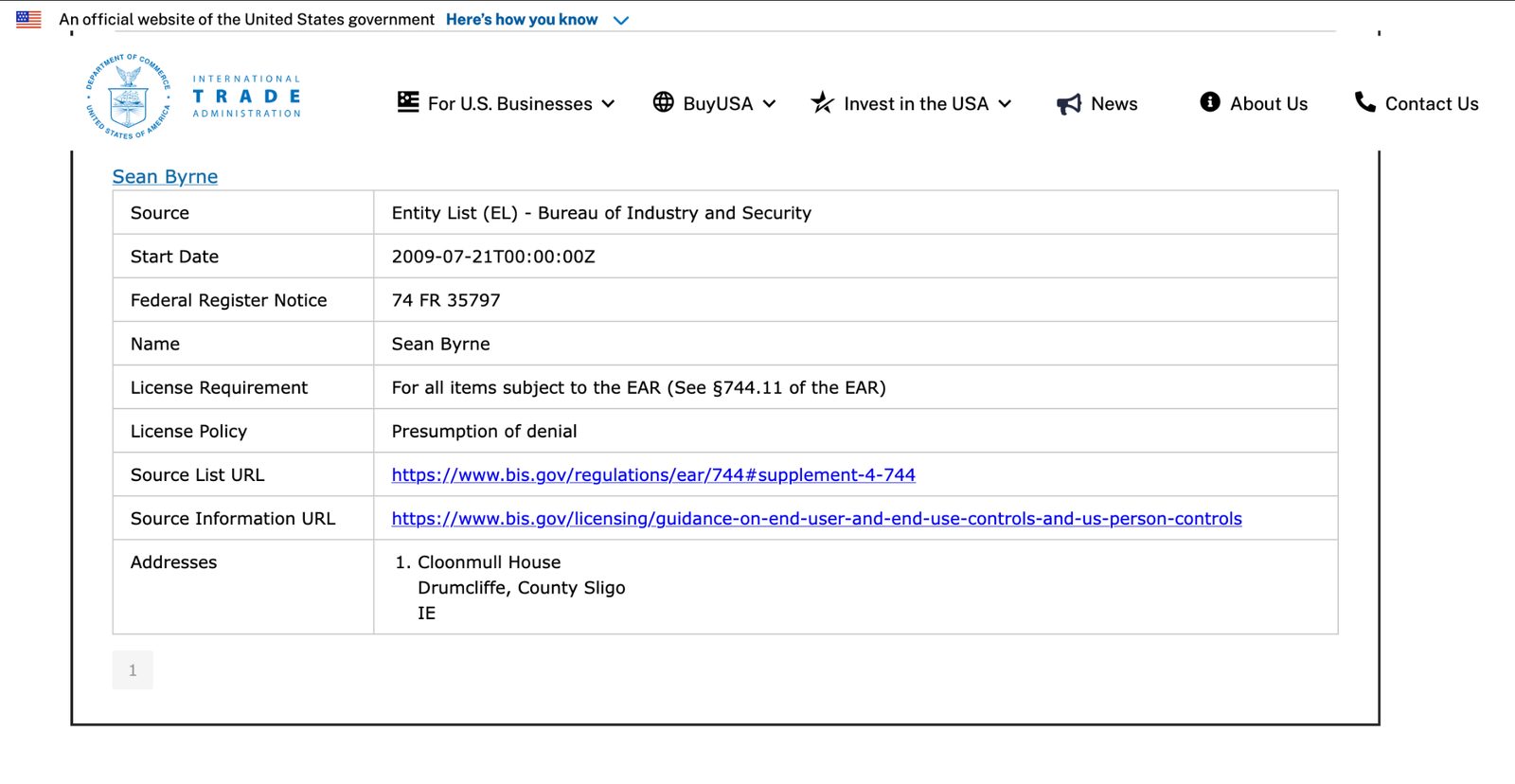
The Consolidated Screening List is not itself a sanctions list — it merges export-control, sanctions and restricted-party lists kept by the Departments of Commerce, State and Treasury. A search for "Sean Byrne" returns exactly one entry: Sean Byrne, Cloonmull House, Drumcliffe, County Sligo, Ireland, added to the Bureau of Industry and Security Entity List on July 21, 2009, with a licence policy of "presumption of denial".
The entry comes from the prosecution of Mac Aviation, an Irish aircraft-parts business. In 2009 the Justice Department described Byrne as its commercial manager and charged him alongside Thomas and Sean McGuinn over illegal exports of U.S. aircraft equipment to Iran. By Byrne's account, Mac Aviation was a father and son working from a cottage outside Drumcliffe who invented employees to look bigger than they were. A superseding indictment in 2010 dropped him as a defendant; the document describes Sean Byrne more than fifteen times as an alias used by co-conspirators. Sixteen years on, the listing still carries no date of birth and no passport number.
Four false positives
It was not the first time. Nasdaq once stopped a share sale after a background check matched his name, and the trade went through only after he supplied more documents. Later DHL, shipping for SpaceX, held up a Starlink mounting pole over a restricted-party match and asked for his passport. Byrne also cites the twelve Americans named Robert Johnson whom 60 Minutes brought together in 2006, and Sandra Cortez, awarded damages after TransUnion wrongly matched her against a sanctioned woman.
Screening that runs earlier
Remote hiring has a documented identity-fraud problem, including North Korean IT workers who use stolen identities and U.S.-based laptop farms; the Justice Department has prosecuted schemes that placed workers at more than 100 U.S. firms. Recruiting products now sit inside applicant tracking systems: Tofu screens applicants across more than forty signals before a recruiter opens a résumé, while Brainner checks applicants against 3.5 billion data points. Byrne notes the screening described runs against OFAC's sanctions list, and that none of it accounts for a real applicant matching a listing for a person who was invented. He has asked the Bureau of Industry and Security's End-User Review Committee to review the 2009 entry, though the standard process is built for a listed person seeking removal.
SiTech — AI-powered web development
We build fast, modern websites and bring AI into real business workflows. Have a project or a question? We'd love to help.