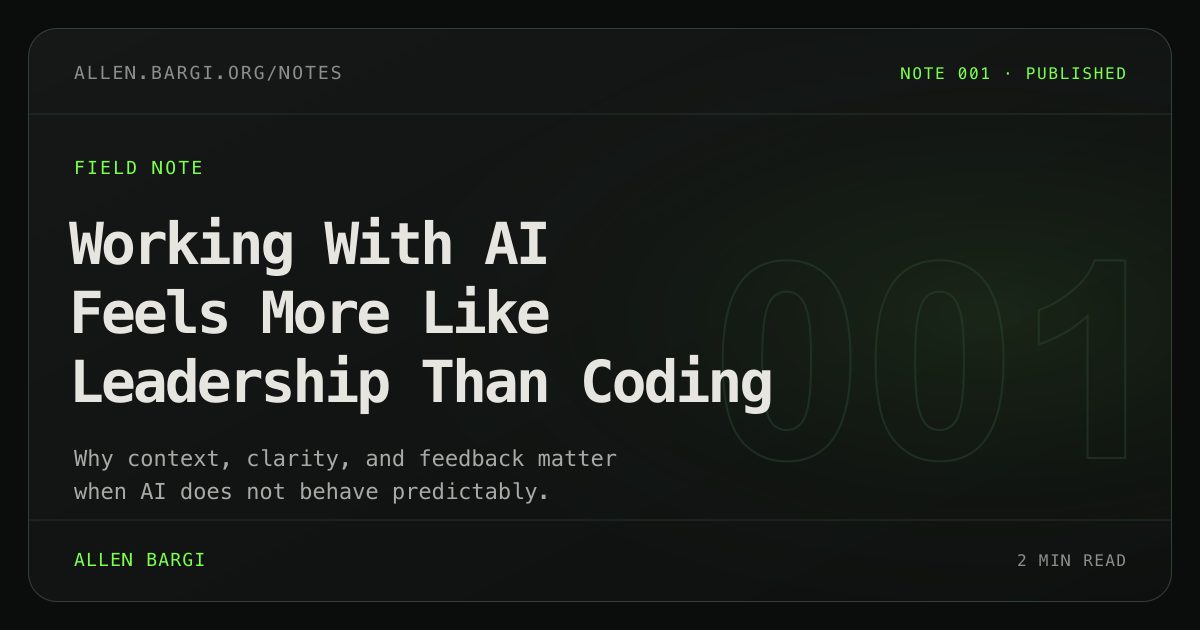
Working with AI feels more like leadership than coding
In a note on his personal site, Allen Bargi argues that working with AI resembles leadership more than programming: the same request can yield different answers, so sharing context and expressing intent matter more than issuing instructions.
In programming, code means certainty: a program does exactly what its instructions say. When the same input produces a different result, developers call it a bug. In a note published on his personal site, Allen Bargi argues that working with artificial intelligence has more in common with leadership than with that kind of programming.
The note, titled "Working With AI Feels More Like Leadership Than Coding," builds on a simple observation about people. A leader can explain a task and get back exactly what was asked for. Just as often, the result is better than the original request, because a colleague understood the intent behind it. Sometimes the outcome shows that the request itself was not as clear as it seemed.
Unpredictable by design
Bargi writes that AI runs on software, but interactions with it are not fully predictable. The same request can produce a different answer: it can make a useful connection, miss an obvious point, or suggest an approach nobody had considered. That behaviour is frustrating when AI is treated like a compiler; it becomes more useful when the interaction is treated as a form of collaboration.
Bargi is careful to separate the analogy from the nature of the technology: the comparison does not make AI a person. It has no lived experience, no accountability and no human judgment. What it shares with a colleague, in his framing, are only the habits that make collaboration work.
Context matters more than prompts
Good leaders, the note continues, do more than issue instructions: they share context, explain the desired outcome, set boundaries and respond to what comes back. According to Bargi, the same habits improve work with AI. A good prompt helps, but a shared working context helps more — examples, corrections and reusable instructions reduce misunderstanding over time, and the system becomes better aligned with how the writer thinks and what he needs from it.
Expressing intent as a skill
The investment, he concludes, is not in pretending that AI is human, but in becoming better at expressing intent. Developers spent years learning to tell computers exactly what to do; now they also have to explain why the work matters, what a good result looks like and where judgment is required. The technology is new, the note says, but the leadership skills are not.
The note prompted a longer discussion among readers on Hacker News, where commenters debated the analogy and shared their own experiences.
SiTech — AI-powered web development
We build fast, modern websites and bring AI into real business workflows. Have a project or a question? We'd love to help.