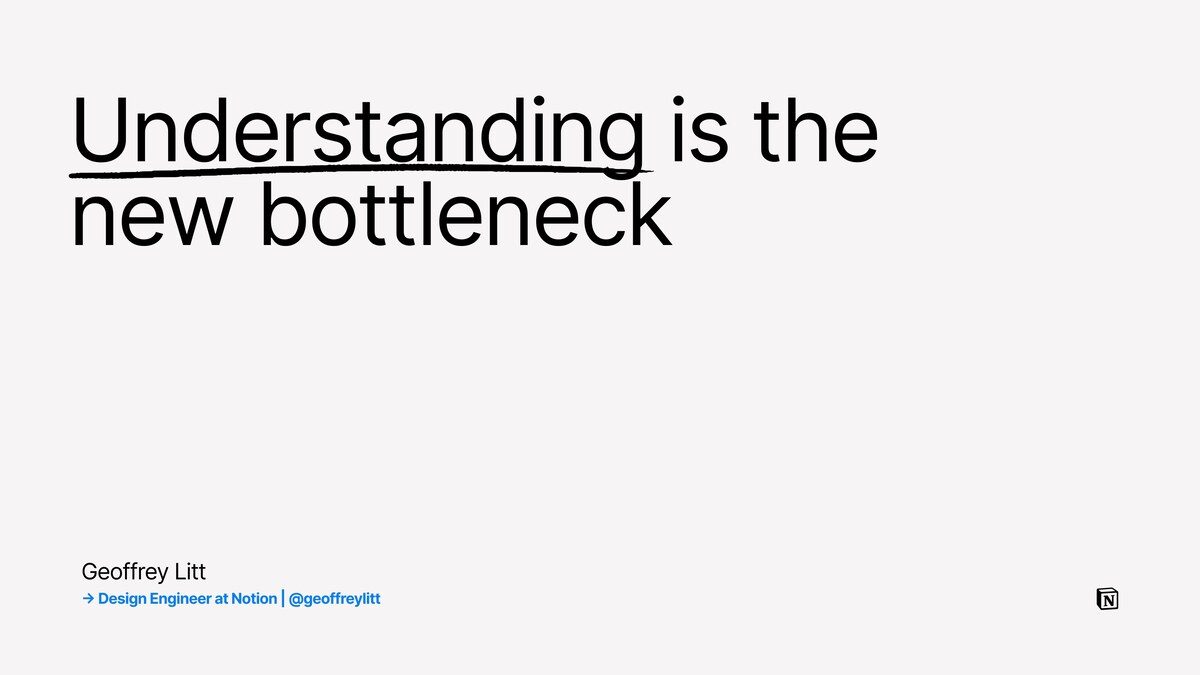
Understanding is the new bottleneck: Geoffrey Litt on keeping up with agent-written code
Geoffrey Litt argues that as agents write more of our code, understanding what they produce becomes the real bottleneck — and that techniques borrowed from education can help people keep up.
Why understanding still matters
In a talk at the AI Engineer conference in July 2026, Geoffrey Litt argued that understanding the code our agents write still matters, even as those agents get better at checking their own work. Verification — deciding whether an output is correct — is not the only reason to read what was built, he says. His answer is participation: a project is many loops with an agent, and the understanding you hold is what lets you propose the next idea and evolve the system. Litt links this to "cognitive debt," a term popularized by Margaret Storey and Simon Willison: like technical debt, a lack of understanding can be ignored for a while, but it catches up eventually.
Explanations, then quizzes
His first technique borrows from education. Rather than reading a raw diff, Litt asks an agent for a structured explainer: his /explain-diff skill produces documents as HTML, markdown or Notion pages that teach the background first, then the intuition, then the code. Changes are rewritten as "literate" prose that walks through the diff in a sensible order. Because reading is easy to fake, each explainer ends with an interactive quiz of about five questions. His rule: he will not send code to others until he can pass the quiz, and he holds reviews of colleagues' code to the same standard. A quiz, he says, is a speed regulator — a counterweight to loops that otherwise run faster than human understanding.
Micro-worlds
The second idea comes from the educator Seymour Papert and his notion of living in "Mathland": people learn by inhabiting an environment, not by reading about it. So Litt asks agents to build small worlds around code. While writing a Prolog interpreter, he built a debugger that let him scrub through execution, watching the stack and rule evaluation step by step. For a personal-website migration he could not meaningfully review, the agent built a small command center where he performed the port himself, step by step, with the old and new sites running side by side.
Understanding together
The third technique is shared spaces. Teams that hold the same mental model share a vocabulary and can think together; without it, collaboration is much harder. Litt, who works at Notion, points to features that let Claude and Cursor agents run inside Notion and leave technical plans in collaborative pages, where teammates can comment immediately. His conclusion reaches beyond code: 50 years ago Alan Kay imagined computers as a new medium for teaching people to think, and AI makes that possibility easier to reach. The point, Litt says, was always to augment people — not only to automate them.
SiTech — AI-powered web development
We build fast, modern websites and bring AI into real business workflows. Have a project or a question? We'd love to help.