Google Gemini 3.7 Flash focuses on coding and agentic workflows
Google's Gemini 3.7 Flash targets coding, agentic workflows and long documents, with reported benchmark gains and introductory API pricing for scalable applications.
Google positions Gemini 3.7 Flash for practical work
Google introduced Gemini 3.7 Flash on August 13, 2026, shortly after Gemini 3.6 Flash. The model is part of Google's Flash family, which is designed to provide strong AI capabilities while supporting fast responses and scalable usage.
Google says Gemini 3.7 Flash improves instruction following, multi-step planning and tool use compared with the previous generation. These capabilities are aimed at coding, document analysis, automation, web development and other workflows that require more than a single response.
Reported gains in coding and long-context tasks
Software development can require an AI assistant to understand an existing codebase, identify a problem, change several files and check the result. Google's published evaluation results show improvements over Gemini 3.6 Flash on several software-engineering and agentic benchmarks.
The company's model card reports a 43.6% score on FrontierCode 1.1, compared with 34.4% for Gemini 3.6 Flash. For a reported 128K long-context evaluation, Gemini 3.7 Flash scored 97.0% on GDM-MRCR v2, while Gemini 3.6 Flash received 91.8%.
These figures are published by the model developer and are not the same as independent real-world testing. Performance on long documents and other tasks can depend on document structure, prompts, retrieval methods and the work being performed.
Introductory API pricing and potential uses
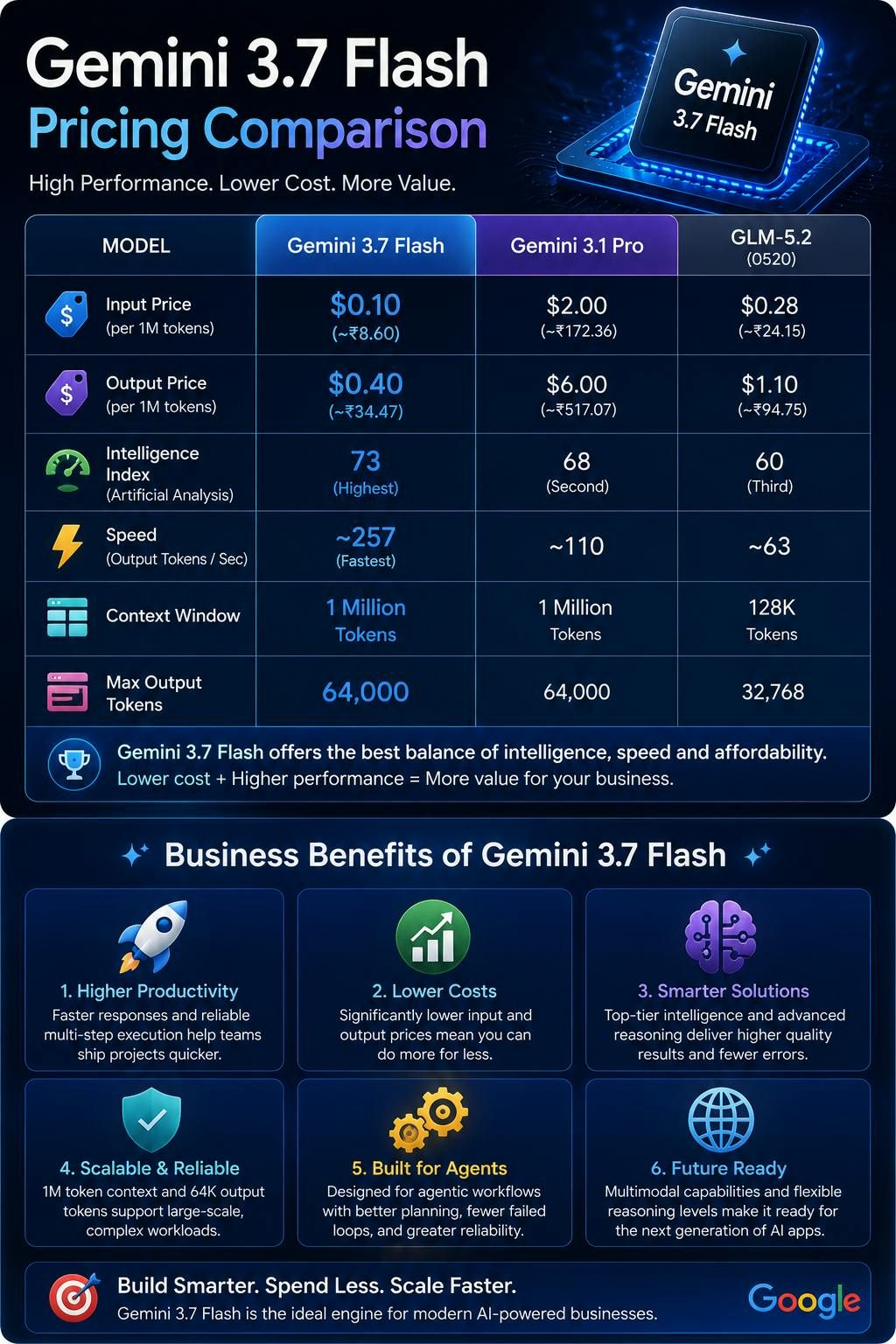
Through December 31, 2026, Google's introductory API price is $0.75 per 1 million input tokens and $3.75 per 1 million output tokens. Standard prices are set to become $1.50 per 1 million input tokens and $7.50 per 1 million output tokens from January 1, 2027.
Developers should assess token prices together with latency, output quality, context requirements and workload type. Possible applications include coding assistants, AI-assisted web development, document analysis, AI agents and knowledge-work systems involving research, information organization and drafting.
For agentic applications, Gemini 3.7 Flash can help determine the next action and interact with available tools. Google specifically highlights improvements in planning and tool calls.
A newer Gemini model has already arrived
Gemini 3.7 Flash was followed by Google's introduction of Gemini 3.8 Flash and Gemini 3.8 Flash Cyber on September 2, 2026. Google describes Gemini 3.8 Flash as an improvement over version 3.7 for software engineering, agentic tasks and multi-step reasoning.
The rapid development of the lineup means that developers should consult current model documentation and test models with their own prompts, data and workflows. Benchmark results can provide a reference, but they cannot guarantee performance in every application.
SiTech — AI-powered web development
We build fast, modern websites and bring AI into real business workflows. Have a project or a question? We'd love to help.